



C-vapor (WEECKE) Flow from submersion to revival
This article is a translation of the following my article:
Original: C-vapor(WEECKE)水没から復活までの流れ
* Translated automatically by Google.
* Please note that some links or referenced content in this article may be in Japanese.
* Comments in the code are basically in Japanese.
by bokumin
Process for reviving a C-vapor (WEECKE) after water damage
This is completely unrelated to the articles I usually write, but I would like to share it in case it is helpful to someone.
How it all started
I bought black coffee from a vending machine near my office. I put it in my bag after work and went home, but it seems like the lid wasn’t closed properly, so a lot of the coffee inside leaked out. .
Fortunately, my computer and other electronic devices were safe (it smelled like coffee).
When I started up my favorite C-vapor (WEECKE), it only displayed the words “Protected E01” and “Protected E02” and would no longer start.
Especially when the Protected E02 error is displayed, it tries to heat up for a moment, but then an error occurs and it stops. I thought it was probably due to an abnormality in the heating chamber.
It’s a matter of life and death if it becomes unusable, so I decided to open it and see what happens.
Broken up homework
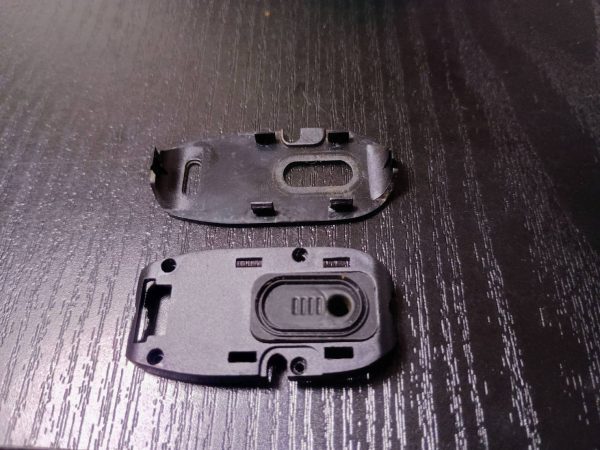
The bottom cover was only fixed with nails, and when removed, four screws were exposed, allowing anyone to disassemble it with a single Phillips screwdriver.
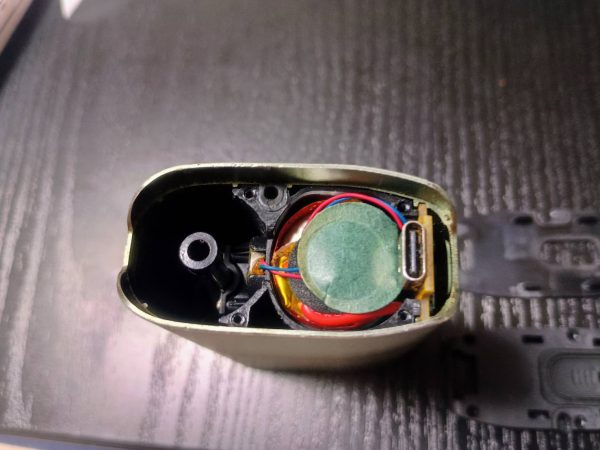
The inside looks like this,
The black part on the left side is the heating chamber. In this state, the heating plate was not visible, so it appears to be inaccessible.
I think the part with the green insulator on the right is the heater control module.
Since the red and blue cables are visible, we can infer that it is supplying and controlling power.
Also, the board is connected to the USB port, and button control etc. are performed here.
Since I don’t know how far the coffee has penetrated, I decided to wipe off as much water as possible with a tissue, seal it up with a desiccant, and see what happens.
Full Resurrection
The next day, I gingerly turned on the power and found that it was working fine. I think it was probably revived because the little moisture left in the heating chamber dried up.
In summary, if an electronic device is submerged in water, it is important to immediately turn off the power, disassemble it as much as possible, and remove the moisture inside. After that, if you seal it up with a desiccant and dry it thoroughly, I think the chances of recovery will increase.
End